The short version: this Redwood fifth wheel got a complete 48V Victron ECOsystem — a 3,000-watt solar array, dual MultiPlus-II inverters, a 4-battery lithium bank, and full system monitoring — sized to run air conditioning, an induction cooktop, and everyday electronics without babysitting the battery bank or watching the state of charge all day.
The Problem With “Good Enough” Solar
Most solar packages are sized for weekend trips: enough to keep the fridge cold and the lights on for a few nights off-grid. That’s exactly what a Weekender or Glamper system is built for, and it covers most RVers just fine.
This owner needed more than that. A rig this size, used for extended off-grid stretches, hits a ceiling fast on a standard system — the air conditioner alone can eat a modest battery bank in an afternoon, and induction cooking, entertainment, and daily electronics stack right on top of it. The real question wasn’t “can we add solar,” it was “can we build a system that never makes the owner think about power at all.”
What We Installed
This was built as a complete Victron ECOsystem — every core component from the same manufacturer, talking to each other, instead of a pile of mismatched parts wired together:
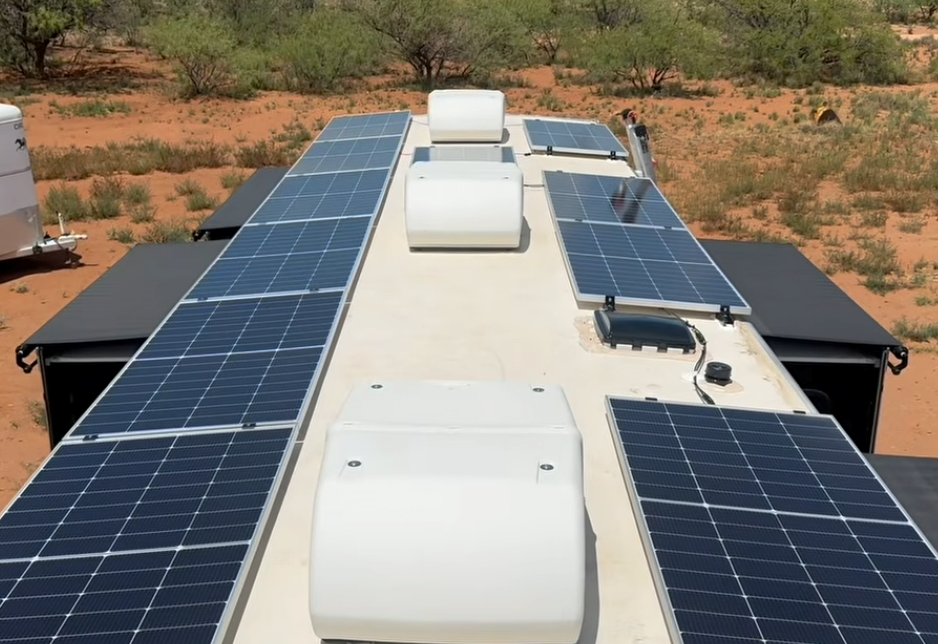
- 12× Rich Solar MEGA 250W panels (3,000W array) — roof-mounted on a clamp system, sized for real daily recovery, not just trickle charging
- Victron SmartSolar MPPT 250/70 charge controller — matches the array to the battery bank efficiently across Tucson’s swing from cool mornings to full summer sun
- 2× Victron MultiPlus-II 48/5000/70-95 inverter/chargers — the “dual 48V inverters,” enough continuous and surge capacity to run high-draw appliances (AC, induction cooktop) without derating or dropping out
- 4× 48V lithium server-rack batteries — the storage side of the system, sized to match the array and inverters rather than being the bottleneck
- Victron Cerbo GX + GX Touch 70 display — full system monitoring, placed where it’s actually usable day to day, plus remote monitoring from home or on the road
- Victron Lynx Distributor, Lynx Shunt & Lynx Power In — the busbar and monitoring backbone tying the battery bank to the inverters and loads, housed in a custom-built rack
- 800A ANL fuse, 2/0 and 4AWG wiring — sized for the real current this system moves, not the minimum code allows
The 48V architecture is the detail worth calling out: stepping up from the more common 12V or 24V setups cuts wiring losses and current draw dramatically at this power level, which is what actually makes a system this size reliable instead of just big on paper.
We also wired in a pair of 50A WAGO connectors as a deliberate safety net — they let the owner bypass the entire 48V inverter/charger system and switch to direct shore power if it’s ever needed, without an electrician having to rewire anything.
A build at this voltage and current isn’t a first-timer’s project — it was installed and commissioned by an ABYC (American Boat and Yacht Council) Certified Electrician and Victron Certified technician, to the same electrical-safety standard marine and RV electrical professionals are held to.
How Big of a Solar System Does a Fifth Wheel Like This Need?
For a large fifth wheel running air conditioning and high-draw appliances off-grid for extended stretches, 2,500–3,000+ watts of solar paired with a properly sized 48V inverter and battery bank is the range that actually delivers “don’t think about it” power — not just “enough for one night.” Anything smaller works fine for occasional dry camping, but it isn’t built for full-time or extended off-grid use.
The Result
The system was tuned with soft-start capability on the air conditioners specifically — so the biggest single power draw in the RV doesn’t slam the inverters every time the AC kicks on. Combined with the Cerbo GX and Touch 70 display, the owner can see exactly what the system is doing from inside the RV or check in remotely from home, rather than guessing at the state of charge.
This is the build we point to when someone asks what “The Monster” package looks like scaled up for a rig that demands more — same certified installation standard, sized to the system instead of a catalog spec sheet.
Thinking about a system built for how you actually use your RV, not just a standard package? Get a free consultation and we’ll size it around your rig and how you camp.