RV Solar Installation in Tucson, AZ: What to Expect
If you’ve searched for RV solar installation in Tucson, you’ve probably found a page full of directory listings — a Yelp “Top 10,” an eTrailer installer map, maybe a roofing company that lists RV solar as an afterthought service. None of it tells you what actually happens when someone installs a solar system on your rig in Southern Arizona, or why that process looks different here than it does in a magazine article written for RVers in Oregon.
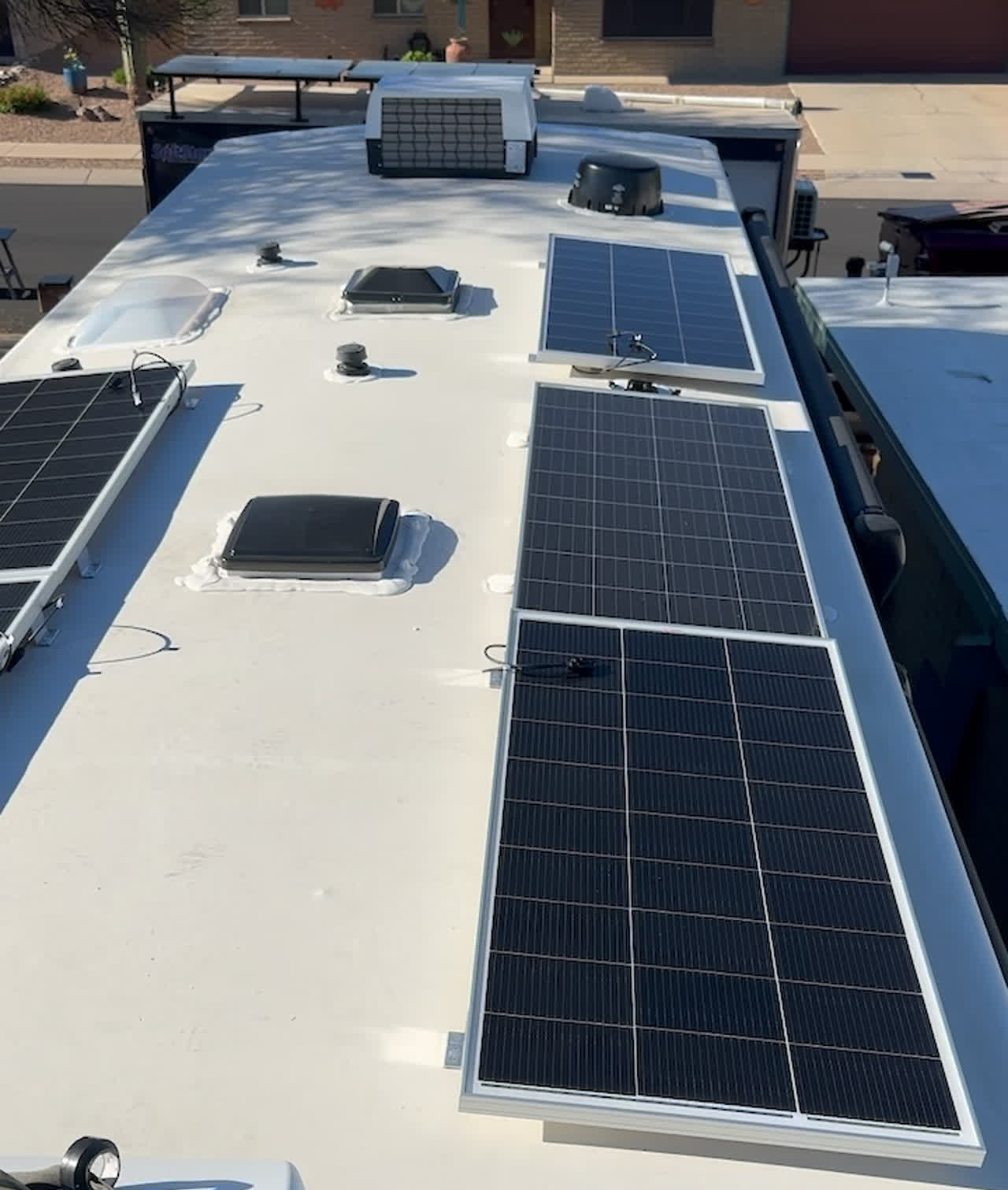
We’ve done this over 200 times on driveways, storage lots, and RV parks from Marana to Vail. Here’s what you’re actually signing up for.
Why RVers in Tucson & Southern Arizona Need a Different Solar Approach
Most RV solar content is written for a generic RVer in a generic climate. Southern Arizona isn’t generic. Two things shape almost every decision we make on a Tucson install: heat and distance.
Desert heat and its effect on system design
A black or dark-colored RV roof in direct Tucson sun in July regularly hits 160–180°F at the surface. That’s not a number you’ll see mentioned in most installation guides, because most of them aren’t written by people who’ve actually put a thermometer on a roof in the Sonoran Desert in summer. It matters for two very practical reasons: the adhesives and sealants used to mount panels and hardware need to be rated for that surface temperature and given proper cure time, and every electrical component in the system — charge controller, inverter, battery bank — needs headroom above its rated operating temperature, not just enough capacity for your power draw.
Long stretches between services on BLM and state land
Southern Arizona has some of the best legal boondocking in the country — BLM land around Tucson, state trust land, dispersed camping near Saguaro National Park. RVers who camp out there aren’t near a dealership if something goes wrong, and they’re often relying on their solar system as their only power source for days or weeks at a time. That changes the calculus on system sizing and redundancy compared to someone who dry-camps occasionally between campground stays.
What a Mobile Installation Actually Looks Like
“Mobile” gets used loosely in this industry. Here’s specifically what it means with us.
The on-site assessment (no towing, no shop visit)
We come to your RV wherever it’s parked — your driveway, a storage facility, an RV park. We walk the roof, check your existing electrical panel and battery compartment, look at your typical power usage (what appliances, how often, how many nights off-grid), and talk through which of our three packages fits how you actually use the rig. You never tow it anywhere or wait for a shop appointment slot.
Typical timeline from quote to finished install
Most installs run one to three days on-site depending on package size and any custom wiring the rig needs — a Weekender is usually a shorter job than a Monster build with a 48V system and expanded battery bank. From first quote call to a finished, tested system, most customers are looking at one to two weeks, largely driven by scheduling rather than the work itself.
The Three Setups We Install Most for Tucson RVers
Weekender — weekend trips to Mt. Lemmon or Catalina
800W of solar and 400Ah of battery capacity. This is the right fit if you’re mostly doing weekend trips — up to Mt. Lemmon for cooler air, out to Catalina State Park, or a few nights at a time away from shore power. Around $8,860 installed.
Glamper — full-time boondockers
Our most popular build, at 1200W solar and 600Ah battery capacity, around $10,045 installed. If you’re living in the rig full-time or spending extended stretches off-grid, this is the package most of our customers land on.
Monster — maximum off-grid capability
A 48V system with 2500W of solar and a 300Ah battery bank (at the higher 48V architecture, that’s a substantially larger usable capacity than a 12V 300Ah bank), around $16,968 installed. This is for RVers who want to run air conditioning, run power tools, or otherwise draw hard on the system without rationing.
What’s Different About Installing in the Desert
Roof surface temperatures and mounting adhesive cure times
Every adhesive and sealant we use is rated for the surface temperatures Tucson roofs actually reach, and we schedule cure time accordingly rather than rushing a job because a forecast looks convenient. An install that looks fine the day we leave but wasn’t given proper cure time in extreme heat is exactly how you end up with a lifted panel edge six months later.
Component derating for ambient heat
Charge controllers, inverters, and wiring are all rated for a maximum operating temperature, and that rating assumes reasonable ambient conditions — not a battery compartment baking next to a black roof in August. We build in headroom on every component rather than sizing to the bare minimum, which is one of the most common corners cut on lower-cost or DIY installs in this climate.
What to Expect on Install Day
You’ll get a walkthrough of the finished system — where everything is, how to read your monitoring, what your realistic power budget looks like day to day, and what maintenance (if any) it needs. We test the system under load before we consider the job done, not just confirm that panels are producing voltage.
Why Certified & Local Matters
NRVIA, ABYC, and National RV Technician credentials
Chris Killeen, who runs every install, is an NRVIA-certified RV inspector, a National RV Technician, and an ABYC Certified Marine Electrician — a credential built around marine 12V/48V DC electrical systems, which maps directly onto RV solar and battery work in a way a general electrician’s background doesn’t.
What 200+ Southern Arizona installs has taught us
Every one of the desert-specific details above — adhesive cure times, component derating, battery placement — comes from installs actually done in this climate, not a manufacturer’s spec sheet written for a temperate market.
Key Takeaways
- A dark RV roof in Tucson summer sun regularly reaches 160–180°F — mounting adhesives, sealants, and electrical components all need to be selected and installed with that in mind.
- Mobile installation means we come to you; most jobs run one to three days on-site and one to two weeks from quote to completion.
- Our three packages (Weekender, Glamper, Monster) map to weekend use, full-time boondocking, and maximum off-grid draw, respectively.
- Long, remote boondocking access in Southern Arizona raises the stakes on system sizing and component headroom compared to occasional dry-camping.
FAQ
Do I need to bring my RV to a shop?
No. We install on-site wherever your RV is parked — driveway, storage lot, or RV park.
How long does an installation take?
Most jobs take one to three days on-site depending on the package, with one to two weeks typical from initial quote to a finished, tested system.
Does Tucson’s heat actually affect the installation itself, or just how the system performs afterward?
Both. Surface temperatures affect how we mount and seal components during installation, and long-term heat exposure affects how we size and place components so they keep performing correctly for years.
Which package do most Tucson customers choose?
The Glamper (1200W solar / 600Ah battery) is our most popular build, typically chosen by full-time RVers and frequent boondockers.
Ready to talk through your setup?
Every RV and every RVer’s power needs are different — the fastest way to know what you actually need is a conversation, not a generic size chart. Get a free quote and we’ll walk through your rig and how you use it.