
We install RV inverter/chargers at your rig, anywhere in the Tucson area. Most are Victron MultiPlus-II: one box that runs your outlets from the batteries, charges them on shore power or the generator, and switches between the two on its own. We pick the right model for your 30 amp or 50 amp rig, size it to your battery bank, test it and show you how it works.
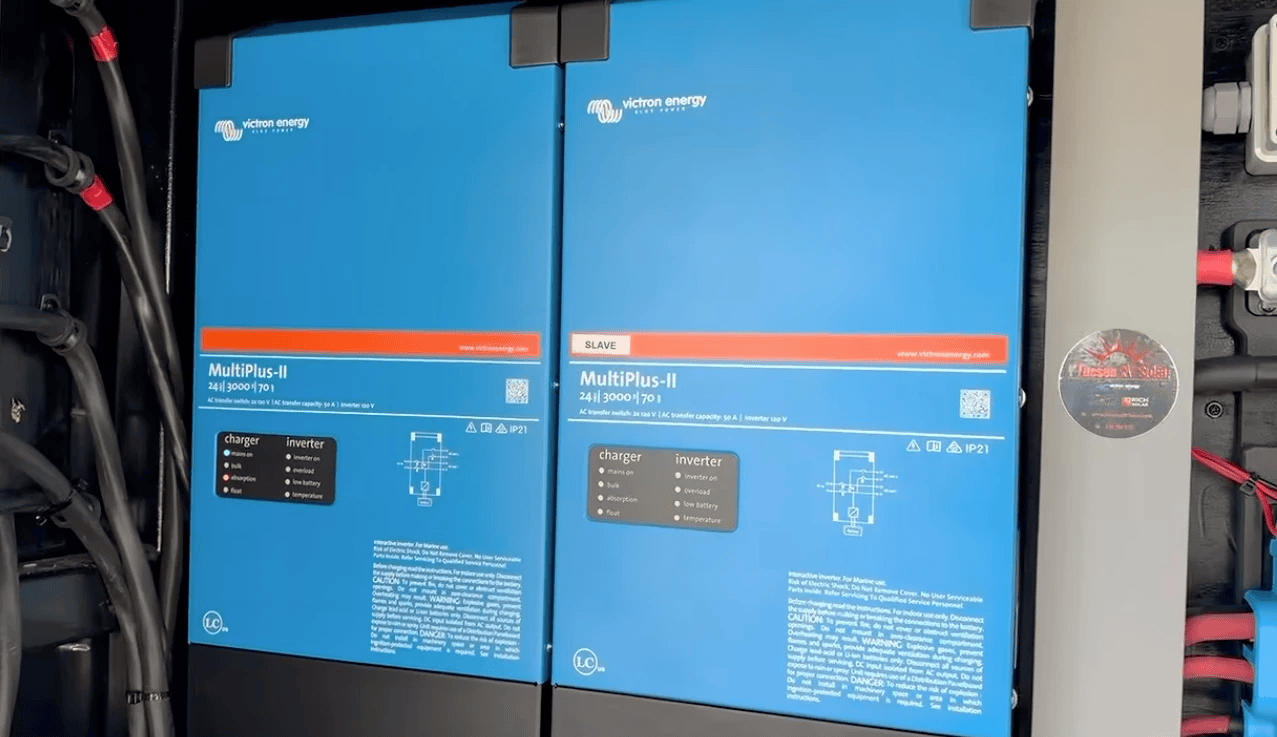
What an Inverter/Charger Does in Your RV
An inverter/charger is three parts in one box:
- An inverter that turns battery power into 120 V for your outlets, TV and microwave.
- A battery charger that runs when you’re plugged in or the generator is on.
- A transfer switch that moves your RV between shore power and battery power without you touching anything.
Plug in and it passes shore power through to the rig and charges the batteries. Unplug and it takes over from the batteries in a split second, fast enough that most clocks and TVs don’t notice.
On most 12 V rigs it also takes over the job of the factory converter, which wasn’t built to charge lithium properly anyway. On 24 V and 48 V systems we keep a small 12 V battery and the house converter, so your lights, water pump and slides stay on their own circuit.
Which MultiPlus-II Fits Your Rig: 30 Amp vs 50 Amp
The short answer: a 30 amp rig gets the standard 120 V MultiPlus-II, and a 50 amp rig gets the 2x120V model. The difference is how many legs your panel has.
30 amp rigs have one 120 V leg. The standard MultiPlus-II 120V feeds it. We set the input limit to match the pedestal, so the charger backs off when you’re running other loads. When you need more than the pedestal can give, the unit tops it up from the batteries (Victron calls this PowerAssist). Your inverter in and out are kept at 30 amps, which is what a 30 amp rig is wired for.
50 amp rigs have two 120 V legs. A standard single-leg inverter only powers half your panel. The MultiPlus-II 2x120V takes the full 120/240 V shore feed and passes it through. When you’re off shore power it ties both legs together, so loads on both sides of the panel keep running from the batteries. The one exception is true 240 V appliances, which most RVs don’t have: they run only on shore power or the generator.
Bigger rigs and 24 V or 48 V systems can run two units in parallel or split across the legs, or the larger 4 kVA and 5 kVA models. We size that from what you want to run and how big your battery bank is.

Every MultiPlus-II has a minimum battery size. The 12 V 3,000 VA model needs at least 400 Ah of battery, so an inverter install often goes hand in hand with a lithium battery upgrade.
Will It Run My Air Conditioner?
Often yes, but it depends on your rig, so we check it first. An RV air conditioner pulls a big surge when it starts. With a soft start on the A/C and a battery bank big enough to carry it, a 3,000 VA MultiPlus-II can run one roof unit. How long it runs comes down to battery size and how hot it is outside. On every A/C job we test the start on the inverter alone before we leave.
If you have an older inverter, such as a Magnum or a modified sine unit, and it won’t run the A/C, it usually has to be replaced, not just reset. See how many lithium batteries you need to get a feel for bank size.
What Install Day Looks Like
We come to you: your home, your storage lot or the RV park. An inverter/charger on its own is a one-day job. A typical day:
- Walk the rig with you. We confirm where the inverter, fuse and cables go, and what has to stay powered.
- Shut everything down safely. Shore power unplugged, generator off, batteries disconnected.
- Mount the unit where it can breathe and be reached for service.
- Wire the DC side. Battery cables are sized to the maker’s manual and ABYC (the stricter one wins), with a Class-T main fuse and a Lynx distribution board where the system needs one. Every lug is torqued to spec.
- Wire the AC side. Shore in, inverter out to your panel, and the case bonded to the chassis.
- Program it. Battery type, charge settings, input limit for your pedestal, and the screen or Cerbo GX if you have one.
- Test everything. Shore charging, inverter output, the transfer back and forth, A/C and microwave, GFCI outlets, and a load test.
- Walk you through it. Where the shutoffs are, how to switch between shore, generator and battery, and what the screen is telling you.

Adding solar, batteries and monitoring at the same time takes two to three days.
What You Get at Handover
You don’t just get a box on the wall. Every install comes with:
- A wiring diagram of your system
- A fuse and breaker sheet
- The equipment manuals
- Warranty information
- Photos of the install
- A phone number that reaches the person who did the work
If you have a Cerbo GX, we set up VRM remote monitoring so you can check your batteries from your phone. Our Cerbo GX setup guide shows what that looks like.

Inverter/Charger Jobs We’ve Done
- Newmar Dutch Star 418: the factory Magnum came out and a Victron MultiPlus-II 12/3000 2x120V went in. We added a 1,200 Ah lithium bank, a soft start on the front A/C, and a touchscreen in place of the Magnum remote. Three days on site in Tucson. See the Dutch Star install.
- Redwood fifth wheel: two MultiPlus-II 48/5000 units on a 48 V server-rack battery bank, built into a custom rack with the Lynx distribution. See the Redwood build.


Mounting It Right in Arizona Heat
An inverter is rated at room temperature. In a closed bay in a Tucson summer, it gets a lot hotter than that, and a hot inverter turns its output down to protect itself. We mount it where air can move, keep clearance around the fan, and add a vent fan when the bay needs one. That’s why a unit we mount keeps delivering in July, not just in January.

Who Does the Work
Tucson RV Solar is led by founder Chris Killeen: ABYC Certified Marine Electrician, Victron Certified installer, National RV Technician, and NRVIA Certified RV Inspector. Most of our installs are Victron because the parts work together, the support is real, and we can monitor what we install. When your rig calls for another brand, we install that too, to the same standard. Meet the team.
RV Inverter/Charger Install FAQ
How much does an RV inverter/charger install cost in Tucson?
It depends on the model, your battery bank and how far the cables run. We quote after a quick look at your rig, so the price you see is the price for your rig.
How long does the install take?
An inverter/charger on its own takes one day. A full system with solar and batteries takes two to three days.
Can you replace my old Magnum or Xantrex inverter?
Yes. We remove the old unit and remote, wire in the new inverter/charger, and replace the old remote with a new screen.
Do you only install Victron?
Mostly, yes. When your rig needs another brand to match existing gear, we install that too.
Do I need lithium batteries for an inverter/charger?
Not always, but the inverter needs a battery bank big enough to feed it. The 12 V 3,000 VA MultiPlus-II needs at least 400 Ah. Most of our inverter jobs pair it with lithium.
Will it work on a 30 amp pedestal if my rig is 50 amp?
Yes. The 2x120V model takes a single 120 V feed and still powers both legs of your panel. Set the input limit to the pedestal and it shares the load with the batteries.
Do you come to me?
Yes. We’re a mobile shop. We work at your home, storage lot or RV park across the Tucson area. See our service areas.
Ready to Add an Inverter/Charger?
Tell us your rig, whether it’s 30 or 50 amp, and what you want to run off the batteries. We’ll tell you what fits.
